
Published Oct 14, 2026
Every year, researchers at Te Herenga Waka—Victoria University of Wellington develop innovations that address complex global challenges. These solutions have transformative potential, but depend on finding the right pathway from the lab to large-scale production.
To help realise that potential, the University’s Technology Transfer Office, Wellington UniVentures, works alongside researchers to identify the commercialisation strategy most likely to translate new discoveries into impact, matching the pathway to the technology, the market opportunity, and the team to drive it forward.
CullBeck, the New Zealand cleantech company pioneering lower-emissions steel production, demonstrates this approach in action.
The technology behind CullBeck emerged from almost a decade of research at Paihau—Robinson Research Institute. Led by Dr Bavinesh Maisuria under the supervision of Professor Chris Bumby, and supported by funding from MBIE's Endeavour Fund and NZ Steel, the research focused on a novel fluidised-bed reactor capable of removing oxygen from New Zealand ironsand using hydrogen instead of coal.
By replacing coal with hydrogen, the process produces water rather than carbon dioxide, creating an opportunity for significantly lower-emissions steelmaking in one of the world's most carbon-intensive industries.
The turning point came when steel industry executive, Martin Hacon, became involved in the opportunity. With extensive experience in steelmaking and decarbonisation, his involvement transformed how commercial development was approached. Together, the team and Wellington UniVentures began exploring commercialisation pathways to maximise the impact of their research alongside Martin.
This ultimately led to the formation of CullBeck, with Dr Bavinesh Maisuria joining as Chief Technology Officer, Chris Jansen as Chief Financial Officer, and Martin Hacon as Chief Executive Officer. Professor Chris Bumby and Professor Matt Watson continue to support the venture as technical advisors.
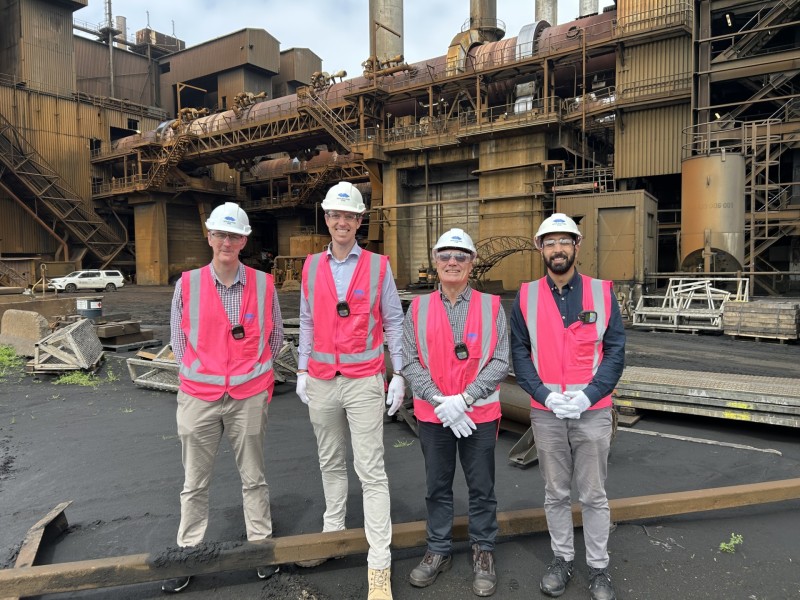
Cullbeck's founding team, Chris Bumby (left), Chris Jansen, Martin Hacon and Bavinesh Maisuria.
As part of this process, Wellington UniVentures worked with the University and researchers to put the right deal structure in place for CullBeck to build momentum and raise the significant capital required to scale the technology ahead of competitors. This included completing a clean transfer of the intellectual property package into CullBeck, enabling all parties to capture fair value from the technology while giving CullBeck clear ownership of the intellectual property.
“Once Martin had assembled his team and CullBeck began working with Wellington UniVentures, it became clear they were the right team to lead the project into its next stage of growth," said Jeremy Jones, Senior Commercialisation Manager, Wellington UniVentures. "We developed a commercialisation pathway tailored to the team and what they needed to advance their technology towards commercial scale. Simplicity was key; by removing friction and unnecessary complexity from the deal, CullBeck was able to move quickly and secure the capital needed to scale.”
The approach reflects a core principle of research commercialisation. It is about finding the pathway that gives each innovation the greatest opportunity to create impact. Some discoveries are best advanced through licensing intellectual property rights to an existing company or setting up a new spin-out with the academic founders, while others benefit from collaborative development arrangements with industry partners. The University takes a flexible, multifaceted approach, and Wellington UniVentures provides a central resource of expertise, contacts, and knowledge, to support academic founders to progress the development and commercialisation of intellectual property.
In CullBeck's case, transferring intellectual property to a new company led by an external CEO, experienced in commercialising green-steel technology, was considered the best way to accelerate the technology's development and potential impact. CullBeck has gone on to raise a record-breaking $15 million first funding round, demonstrating how the right commercialisation pathway, combined with the right team, can help transform university research into a competitive venture, working to reduce emissions in steel production, while taking New Zealand R&D to the world.
Get in touch with us to find out more:

Share this page